The Post-CVSS Enterprise: Navigating vendor consolidation, telemetry decay, and the new rules of vulnerability management

Executive Summary
The collapse of universal NVD enrichment, driven by exponential CVE growth, has broken the legacy vulnerability‑management model that depends on line‑item CVE scoring and automated scanner telemetry. Federal prioritization through CISA’s KEV catalog remains narrow, covering less than one percent of disclosed vulnerabilities, leaving enterprises without reliable public signals to drive remediation.
At the same time, major vendors such as Cisco and F5 are shifting to consolidated “hardened releases" and umbrella CVEs, limiting granular disclosure to reduce AI‑assisted exploit development. This creates a structural mismatch: modern software is serviced through opaque, cumulative releases, while enterprise GRC frameworks still demand CVSS‑based, flaw‑level compliance.
To remain defensible, enterprises must pivot from rivet‑level vulnerability accounting to structural assurance, emphasizing version adherence, vendor maintenance velocity, architectural controls, and procurement requirements such as SBOMs and signed build attestations.
The Long Road Out of Eden
For over two decades, the National Vulnerability Database (NVD) operated as the primary central engine for secondary telemetry. Over time, raw CVE disclosures were systematically enriched with Common Platform Enumeration (CPE) software identifiers, standardized CVSS base scores, and CWE taxonomy categorizations.
Enterprise vulnerability and remediation teams came to rely on this structured data to evaluate exploitation probability, measure business impact, and enforce written compliance policies. For years, this operational model followed a predictable, linear pattern anchored by centralized telemetry.
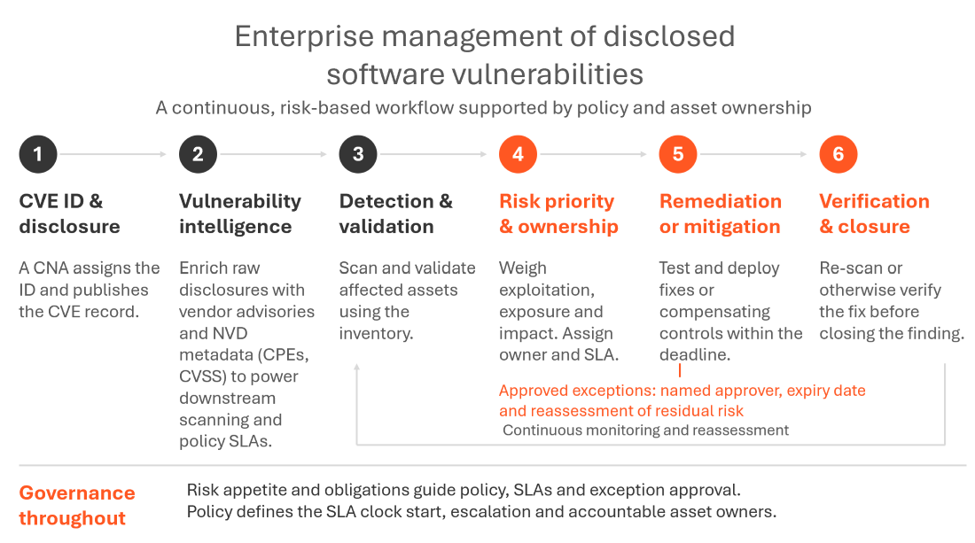
For two decades, this continuous loop worked because Step 2 was guaranteed. When a CVE Numbering Authority (CNA) assigned a CVE ID, NIST/NVD routinely appended CPE hardware and software identifiers, standardized CVSS base scores, and CWE categorizations within days.
That guarantee no longer exists. The breakdown was not caused by bureaucratic inertia, but by a sheer scale mismatch. As automated discovery tools, continuous scanning, and AI fuzzing expanded across the software ecosystem, the volume of raw CVE disclosures exploded exponentially, drowning centralized enrichment pipelines under a flood of incoming submissions.
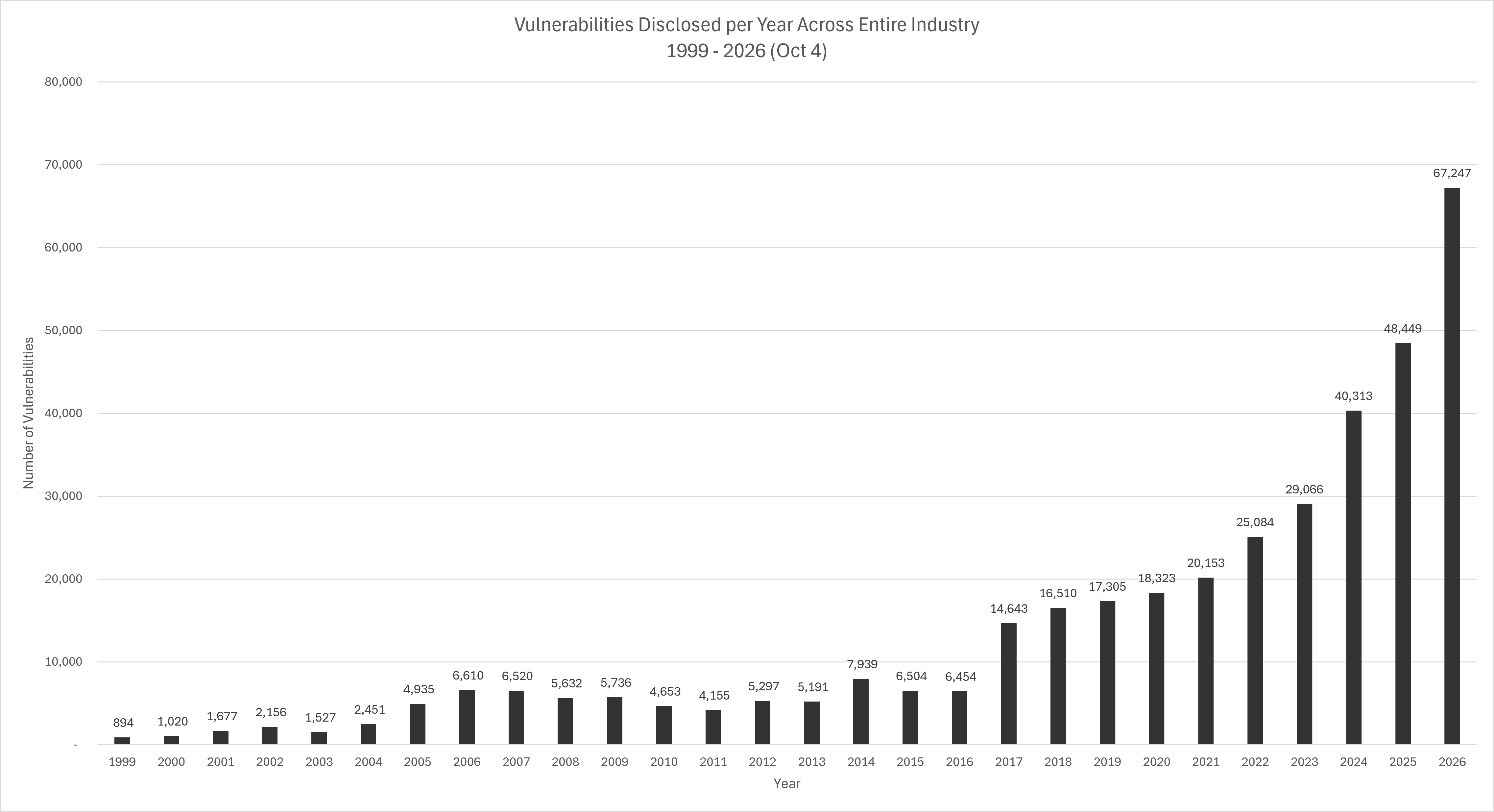
Facing this flood, NIST’s centralized model reached an operational breaking point. The transition from universal enrichment to selective prioritization meant that thousands of raw CVEs began entering the ecosystem as unmapped text strings, devoid of the CPE identifiers and CVSS base scores required to trigger automated scanner alerts and activate internal patching SLAs.
The NVD Enrichment Bottleneck
On February 13, 2024, NIST published an NVD Program Transition Announcement acknowledging operational delays while attempting to build an external consortium model. This marked the beginning of a massive backlog, leaving thousands of newly assigned CVEs unanalyzed without product mapping (CPEs) or CVSS scores.
As annual disclosure volumes expanded toward record highs, NIST officially adapted its operational model to discontinue universal 100% enrichment. Instead, NVD transitioned to a selective triage model prioritizing only specific subsets, such as the Cybersecurity and Infrastructure Security Agency (CISA) Known Exploited Vulnerabilities (KEV) entries, critical federal assets, and Executive Order 14028 related software.
Operational Impact on Enterprise Scanners
Automated vulnerability scanners (Qualys, Tenable, Rapid7) and enterprise asset mapping tools often rely directly on NVD CPE strings to match published flaws against corporate software inventories. Without NVD enrichment, a published CVE ID may remain an unmapped text string in many tools. In those cases, vulnerability management platforms may fail to automatically trigger policy SLAs or generate asset risk alerts, leaving security operations teams blind to open exposures across their environments.
Federal Prioritization in Perspective: KEV as an Administrative Record
In November 2021, CISA launched the KEV catalog through Binding Operational Directive (BOD) 22-01. The mandate was straightforward and necessary: cut through theoretical CVSS scores by establishing an authoritative, evidence-based list of flaws actively exploited in the wild. For federal civilian agencies, and the thousands of private enterprises that adopted KEV as a benchmark, it provided a much-needed filter to force emergency remediation where real-world risk was demonstrably highest.
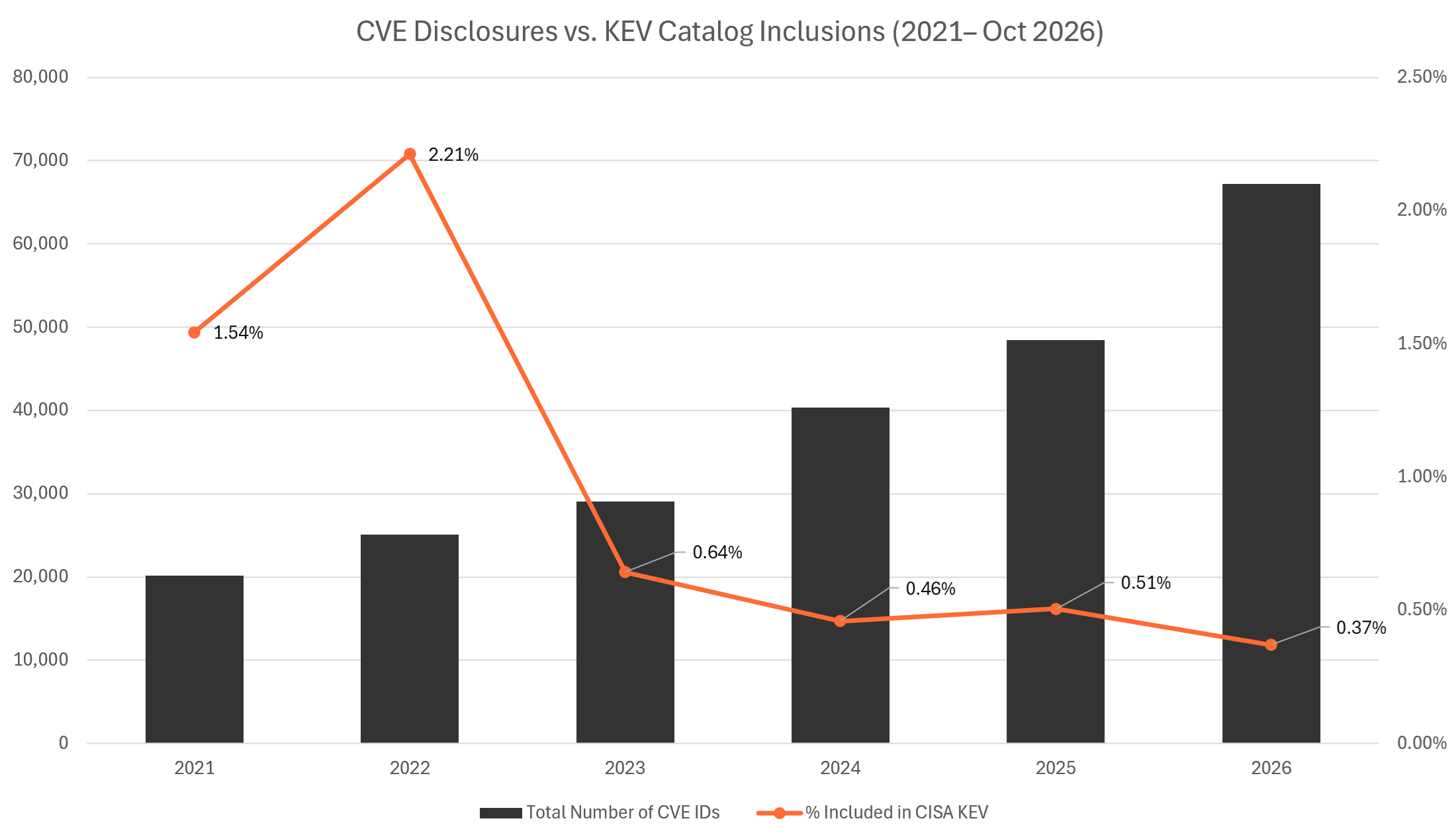
As 2026 annualized disclosures surged past 67,000, the KEV catalog’s operational role subtly shifted. Designed as a rapid triage mechanism, it has increasingly functioned as an administrative record of established incidents. In reality, KEV was never a real-time early-warning radar; decades-old CVEs are routinely added to the catalog every year, yet many enterprise GRC programs still treat it as a primary trigger for emergency remediation SLAs.
While global CVE assignments have accelerated at a steep, exponential pace, annual additions to the KEV catalog have grown only modestly, on the order of a few hundred entries per year, while total CVE disclosures have climbed into the tens of thousands, leaving KEV covering well under 1% of published vulnerabilities. This widening gap is driven by strict evidentiary thresholds. To prevent the catalog from drowning in noise, CISA requires verified, active exploitation in the wild, filtering out theoretical proof-of-concepts, automated scanning, and non-federal software.
Consequently, as disclosure volumes soar, the KEV catalog covers an ever-smaller percentage of published flaws. Figure 3 illustrates this structural decoupling between raw vulnerability creation and federal prioritization.
The Shift to Hardened Releases & Consolidated Servicing
Compounding the degradation of public telemetry, major enterprise infrastructure and software providers are fundamentally altering their security servicing models. To mitigate customer patch fatigue and counteract AI-assisted exploit generation, some vendors are moving away from granular, point-in-time security bulletins toward cumulative "hardened" maintenance releases and umbrella vulnerability disclosures.
Rather than publishing discrete advisories for every individual flaw, industry leaders, such as Cisco and F5, are pioneering consolidated release models that bundle stability enhancements, internal refactoring, and multiple security fixes into regular maintenance cycles.
In a July 2026 policy announcement detailing its transition to a risk-based disclosure model, citing the “rapid evolution of AI-driven cyber threat discovery and mitigation”, Cisco outlined its shift toward software hardening releases and consolidated umbrella tracking:
"Vulnerability Management: Cisco is systematically evaluating our product portfolio to identify and address security vulnerabilities. Vulnerabilities that share common weaknesses (CWE) are consolidated into 'umbrella' CVE IDs, assigning a CVSS score based on the highest severity within that category."
In a July 2026 announcement detailing F5’s transition to an accelerated release cadence driven by frontier AI models, Chief Product Officer Kunal Anand articulated the strategic rationale for restricting line-item disclosure detail:
"Each release will contain a broad set of fixes. These will come from our AI scanning, from the issues that surface as we chase those findings down, from internal teams and outside researchers, and from our own security and stability hardening. As frontier models keep improving, discovery will keep accelerating, and these releases will include a growing number of issues...
Our guidance has always been to run the latest release. That is truer now more than ever. I strongly urge you to deploy these releases as quickly as you are able, and not only for the critical severity issues. Across the industry, attackers are increasingly capable of chaining low- and medium-severity vulnerabilities together into novel exploits, so the severity of an individual fix is a less reliable guide to its importance. Treat every release as though it closes a critical gap...
We will limit the detail we disclose about specific fixes in each release. Given what these models can do, we are not going to hand attackers a roadmap to locate vulnerabilities and build exploits against them before customers are able to patch."
The GRC Friction Point
For front-line vulnerability management and operations teams, this structural evolution creates a profound operational paradox.
Enterprise risk management models were built on the assumption of granular visibility: a scanner identifies a specific CVE ID, a CVSS base score dictates the internal SLA, and a targeted patch is deployed to address that exact finding. Consolidated maintenance releases dismantle this entire paradigm.
When vendors redact line-item vulnerability details and collapse multiple flaws into umbrella CVEs, enterprise teams face three severe operational hurdles:
1. Telemetry Blind Spots: Vulnerability management platforms lose the granular signatures needed to pinpoint specific exposures or verify whether a given sub-component fix is installed.
2. Policy Incompatibility: Internal GRC frameworks that mandate fixed remediation timelines based on individual CVSS thresholds (e.g., "Critical = 14 days") cannot process a monolithic release containing undisclosed, unscored, or aggregated fixes.
- The Resource Disadvantage: The traditional "just patch everything" mantra breaks down in complex enterprise environments. Without granular risk data, understaffed operations teams cannot evaluate the relative risk of deploying a massive, potentially disruptive infrastructure update against the risk of remaining on a previous build.
Ultimately, vendor release engineering is adapting to the speed of modern threat actors, but enterprise governance remains tethered to a legacy model of line-item tracking. The result is a widening structural rift between how software is serviced and how security risk is governed.
The Detection Gap: Scanner Realities in a Hardened Landscape
As infrastructure vendors transition to consolidated releases, vulnerability management platforms are forced to overhaul how they assess asset risk. The assumption that every security risk manifests as a discrete CVE-202X-XXXX signature is breaking down.
In practice, vulnerability scanners adapt to this shift along two distinct paths, exposing a growing operational divide across enterprise infrastructure:
· Advisory-Based Telemetry Replacing CVEs: Leading scanning engines no longer rely solely on CVE assignments. When vendors issue consolidated security fixes under proprietary tracking IDs, such as Cisco Security Advisories (cisco-sa-*) or F5 Knowledge Base advisories (K-prefixed), scanner vendors author custom detection plugins mapped directly to the vendor's proprietary advisory. The atomic unit of vulnerability tracking is shifting from public standards to vendor-specific namespaces.
· Platform-Specific "Train" Compliance: Rather than checking for individual bug signatures, scanners are increasingly tasked with evaluating whether a system adheres to a vendor’s recommended "hardened train" or Long-Term Stable (LTS) branch. On platforms like Cisco IOS XE, scanner plugins (such as Tenable’s hardening‑release detections) explicitly flag devices missing vendor‑supplied hardening releases, effectively treating adherence to the hardened train as the unit of compliance.
· The Coverage Asymmetry: This model breaks down on platforms where vendor-recommended train compliance is not modeled as a discrete plugin category, such as F5 BIG-IP or legacy switching architectures. While a scanner can flag known advisories on an edge device, it might not be able to answer a CISO’s fundamental operational question: "Is this appliance running on a supported, hardened branch?"
The GRC Paradox: Adapting Corporate Policies to New Telemetry
The operational pivot toward version adherence inevitably runs headlong into enterprise governance frameworks built for a previous era. Most corporate vulnerability management policies, third-party risk assessments, and regulatory compliance attestations are explicitly calibrated to line-item CVE accounting. They mandate rigid, severity-based SLAs, typically requiring critical CVSS scores to be remediated within 14 to 30 days, verified by clean line-item scanner reports.
When an infrastructure vendor transitions to consolidated, hardened releases, this legacy governance model collapses into a paradox:
1. The Audit Penalty: An asset running a vendor’s latest hardened build may still trigger scanner alerts for individual sub-component CVEs because the scanner lacks granular visibility into the redacted release. Under legacy rules, the enterprise appears non-compliant, despite running the most secure software state available.
- The SLA Misalignment: When vendors publish umbrella CVEs or redact granular severity scores, automated GRC workflows fail to assign traditional SLA clocks. Operations teams are left without the telemetry required to justify emergency change windows to internal risk committees.
To resolve this paradox and establish a defensible posture in a post-CVSS ecosystem, security leaders must modernize enterprise strategy across five core pillars:
1. Policy Recalibration: Rewrite corporate vulnerability management standards to incorporate Version Adherence SLAs alongside traditional CVE metrics. For infrastructure platforms operating under consolidated release models, define compliance by supported release windows (e.g., "Deploy vendor-hardened maintenance builds within 30 days of publication") rather than individual flaw resolution.
2. Audit & Regulatory Realignment: Proactively engage internal audit, risk committees, and external assessors to establish new evidentiary standards. Demonstrating that an asset is running an actively supported, vendor-hardened release must be formally recognized as equivalent, or superior, to a line-item patch attestation.
3. Modernized Vendor Risk Assessments: Overhaul vendor evaluation metrics to stop penalizing vendors with high raw CVE counts. Instead, evaluate software providers on delivery velocity, build transparency, release reliability, and regression history. In an era of AI-driven vulnerability discovery, a vendor disclosing many flaws and shipping frequent, reliable hardened builds is safer than one maintaining telemetric silence.
4. Architectural Fortification: As edge platforms and core infrastructure become more telemetrically opaque, security teams must shift risk mitigation from local patching to architectural control planes. Enforce strict identity-based access, micro-segmentation, and zero-trust boundaries around infrastructure assets to reduce exposure to unmonitored or uncataloged flaws at the network perimeter.
5. Contractual & Procurement Expectations: As vendors limit granular disclosures to hinder AI exploit generation, enterprise buyers must demand alternative verification mechanisms at the negotiation table. Procurement teams should require vendor attestations of build integrity, cryptographically signed Software Bills of Materials (SBOMs), and guaranteed long-term maintenance support windows.
Ultimately, enterprise governance must reflect how modern software is built, serviced, and defended. When public telemetry databases buckle under macro disclosure volumes, federal catalogs narrow their scope, and major infrastructure vendors are reducing or consolidating line‑item disclosures to protect against AI‑assisted exploitation, clinging to legacy metrics becomes self-defeating.
Retaining rigid, line-item CVE compliance models for platforms that no longer disclose or service vulnerabilities at the line-item level, relying on scanner metrics that miss the structural reality of consolidated maintenance builds, does not manage enterprise risk. It merely incentivizes compliance theater over actual security.
References
February 13, 2024 Announcement: NIST NVD Program Transition Announcement
NVD News Page & Status Updates: NIST NVD News & Operational Status