The Most Underrated Cybersecurity Control: Outbound Least Privilege

Executive Summary
Enterprise cybersecurity has spent decades concentrating on preventing attackers from getting in while paying far less attention to what compromised accounts, systems, workloads, and applications can do once they establish initial access. I argue that one of the most undervalued controls in modern security is applying the principle of least privilege to outbound network connectivity. Internet access should be treated as a privilege, not a default.
Outbound least-privilege controls can disrupt phishing, malware delivery, command-and-control communications, data exfiltration, and adversary abuse of trusted cloud platforms. By limiting users, workloads, and applications to only the external destinations required for legitimate business purposes, organizations can materially reduce attack paths, increase attacker cost, and generate valuable detection signals.
Recent advances in SASE, SSE, CASB, and cloud-native security services have made identity-aware egress controls practical at enterprise scale. At the same time, the rise of agentic AI has made outbound governance more important than ever. Autonomous agents capable of selecting tools, calling APIs, and interacting with external services require tightly bounded connectivity to contain risk and prevent unauthorized actions or data disclosure.
Ultimately, outbound least privilege is an exercise in resilience economics. The objective is not to eliminate internet access, but to ensure every outbound connection is intentional, bounded, observable, and accountable. Organizations that constrain egress force attackers into fewer, less reliable, and more detectable pathways while preserving the flexibility required for modern cloud and AI-driven operations.
The Most Underrated Cybersecurity Control: Outbound Least Privilege
The principle of least privilege should apply to network connectivity just as rigorously as it applies to identities and permissions. The concept is simple: reducing standing privileges for users and systems helps reduce the potential blast radius when those accounts get compromised. Giving accounts only access to systems and data they absolutely require to perform their jobs has been a foundational best practice for decades.
However, the principle of least privilege has been more challenging to embrace than it should be. IT administrators tend to allocate broad “birthright” privileges when accounts are provisioned in order to reduce the administrative overhead associated with ongoing management, enabling users and IT workers to embrace the self-service IT support that has been so popular for the last couple of decades. This model also allows organizations to constrain the operational costs associated with ongoing account administration.
Nowhere is this neglect more glaring than at the network boundary. For over two decades, enterprise network defense has invested heavily in ingress inspection while applying far less rigor to outbound connectivity.
Modern enterprise perimeters are built like heavy fortress walls with wide-open rear exits. Once an adversary bypasses initial access controls, whether through a zero-day exploit, a stolen session cookie, or a compromised supply-chain dependency, they encounter an environment where many servers, containers, and workload identities still retain broad or default outbound access to the public internet, frequently with less scrutiny than inbound connectivity.
Outbound connectivity should be treated as a privilege, not an application default.
The goal is not to block the internet indiscriminately, but to give each user, workload, and AI agent only the external connectivity required for its approved purpose. When enforced across protocols, destinations, tenants, identities, and data paths, outbound least privilege disrupts phishing, malware delivery, command and control, unauthorized SaaS use, and data exfiltration while generating valuable detection signals. In the agentic enterprise, these controls become essential guardrails for systems capable of independently selecting tools, calling APIs, and acting on sensitive data.
How Egress Filtering Disrupts Attack Playbooks
An easy way to understand how egress filtering makes attackers’ lives more difficult is to consider how a simple phishing attack works. Attackers send their target user an email crafted to look like it is from a legitimate organization, instructing them to click a URL. When the user clicks, their browser resolves the domain via DNS, establishes a TCP three-way handshake, and makes an HTTP request.
If the outbound policy denies the destination or service, the browser cannot establish the required network session and the credential-harvesting page does not load. The user may still click the lure, but the attack is interrupted before credentials can be submitted to that destination. Egress controls therefore create a powerful last line of defense even after the user has taken the bait.
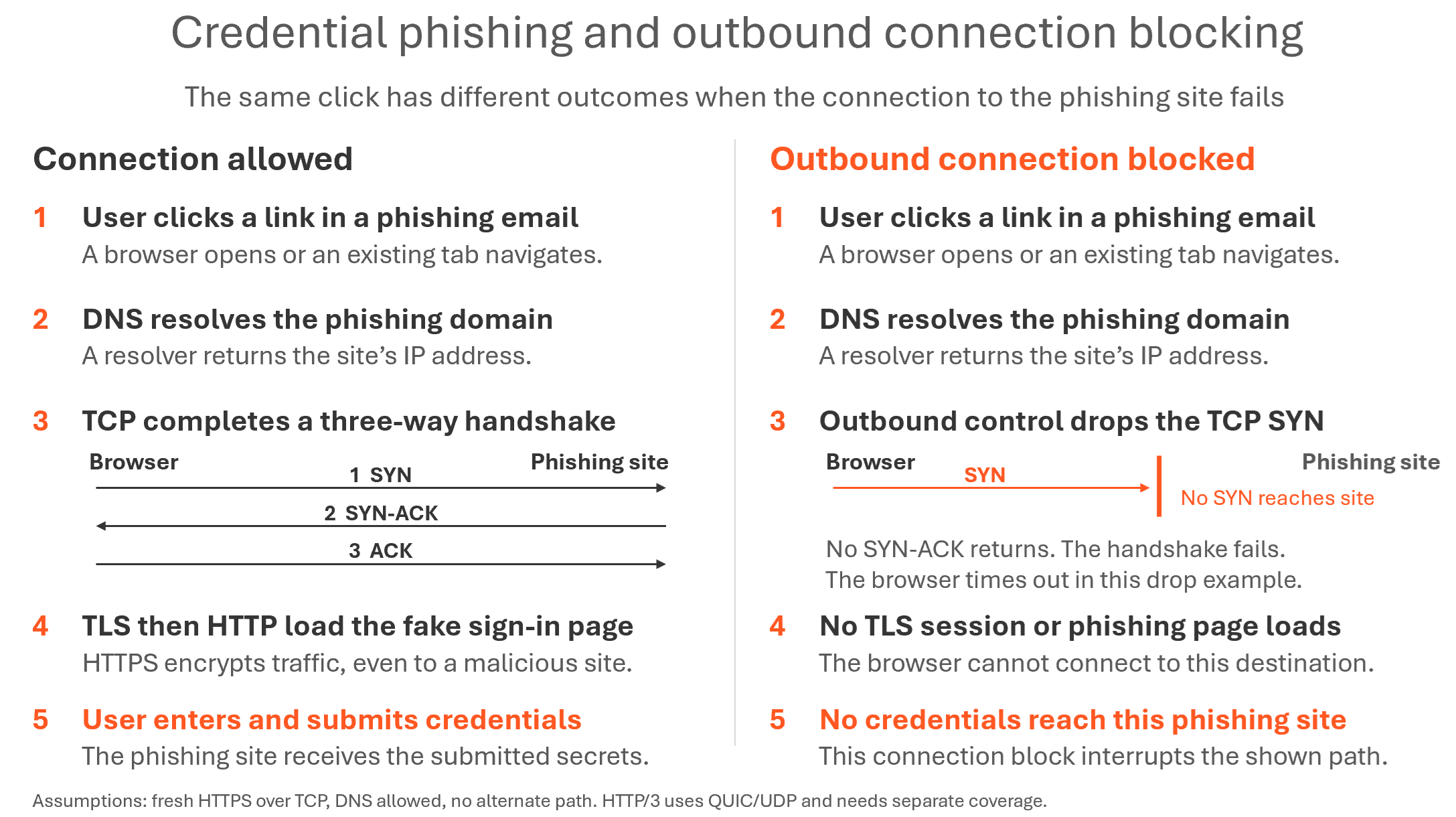
Figure 1: Simplified anatomy of an egress block. In this TCP example, the outbound policy drops the initial SYN, preventing session establishment and stopping the browser from reaching the phishing page through that connection.
Aggressive egress filtering similarly disrupts common post-compromise playbooks:
· Disrupting C2 and Malware Downloads: It can prevent attackers from retrieving tools and malware from unauthorized destinations and sever command-and-control channels that depend on blocked external infrastructure.
· Throttling Exfiltration: Blocking most of the internet makes it significantly harder for attackers to exfiltrate stolen data to external drop sites. Most modern attacks depend at some stage on network communication, whether to retrieve payloads, establish command and control, access cloud services, or transfer stolen data. Restricting those communications can materially increase attacker cost and reduce the number of viable paths.
· Targeting Living Off Trusted Sites (LOTS): Blocking destinations already known to be malicious is comparatively straightforward. The harder problem is adversary use of legitimate, widely permitted services where malicious and business traffic share infrastructure. Utilizing insights from the Living Off Trusted Sites (LOTS) Project, attackers abuse common utilities like dropbox.com, drive.google.com, github.com, or amazonaws.com. Enforcing granular egress control can limit these services to explicitly authorized users, workloads, tenants, and use cases, forcing adversaries through additional hurdles and creating valuable detection opportunities.
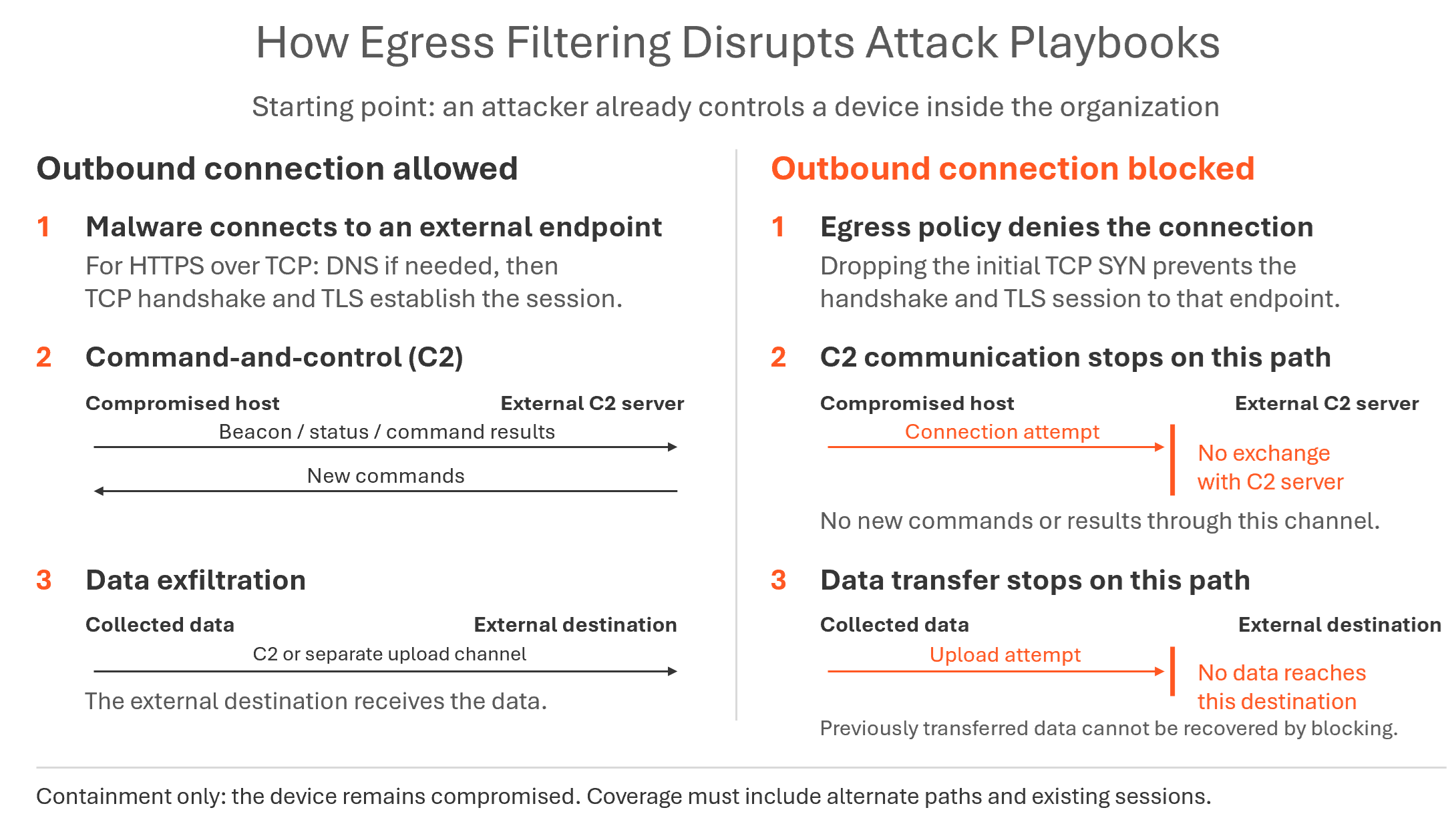
Figure 2: Outbound policy enforcement blocks communication to unauthorized destinations, disrupting C2 and exfiltration over those paths. Coverage must include alternative protocols, permitted cloud services, existing sessions, and other egress routes.
Operationalizing Egress at Cloud Scale: The Convergence with SASE
Historically, enforcing egress filtering across dynamic cloud environments meant managing brittle IP allowlists and high-maintenance NAT gateways. That operational friction is precisely why many enterprises historically abandoned outbound least-privilege policies. Attempting to enforce egress filtering using static layer-3/4 firewalls in modern large-scale hybrid environments is fundamentally unsustainable.
This is where the convergence of Secure Access Service Edge (SASE) and Security Service Edge (SSE) changes the equation. SASE can make destination and identity-aware egress controls practical at distributed scale:
· Dynamic Domain and Category Allowlisting (SWG): Reduces dependence on static IP allowlists by applying identity-aware, domain- and category-based policies that can better accommodate provider address changes.
· Tenant Isolation and Instance Control (CASB): CASB instance controls can reduce sanctioned-SaaS abuse by distinguishing approved and unapproved tenants where supported.
· Decoupled Inspection Overhead (FWaaS): Shifts TLS inspection and deep-packet inspection from local gateways to distributed cloud infrastructure, potentially reducing local compute and bandwidth bottlenecks. TLS inspection should be applied selectively based on risk, privacy, regulatory requirements, application compatibility, and certificate-pinning constraints.
It is important to understand that the objective is not a single universal internet allow-list. The objective is bounded outbound connectivity: giving each user, workload, application, and service only the external access required for its authorized purpose. Decisions should increasingly be made based on identity, workload, protocol, destination, tenant, and data sensitivity rather than broad network reachability.
The Agentic Imperative: Governing Autonomous Workforces
As enterprises deploy autonomous AI agents into production pipelines, the nature of outbound internet access undergoes a fundamental paradigm shift. Conventional applications generally follow predefined logic and known integration paths. AI agents may dynamically interpret input, select tools, call APIs, and execute multi-step workflows, making their behavior and external dependencies less predictable than those of conventional applications.
Without outbound least privilege, an autonomous agent workforce introduces a massive, unmanaged execution plane:
· Containing Non-Deterministic Blast Radius: Because LLM-driven agents evaluate unbounded user input, they are vulnerable to indirect prompt injection. An attacker can embed malicious instructions inside an invoice PDF or customer ticket, instructing a reading agent to harvest internal context and transmit it externally. Applying least privilege to agentic egress can constrain an agent responsible for updating financial records in Salesforce to approved Salesforce API endpoints and enterprise-controlled gateways.
· Eliminating Shadow AI and Unvetted Telemetry: Business units routinely deploy cloud-hosted agentic frameworks that silently connect to external vector databases, unapproved model providers, or third-party diagnostic services, leaking proprietary enterprise context. Architectures that deny direct egress and expose only approved brokers or gateways can force model calls and selected external tool executions through authenticated control points.
Network egress is only one boundary in an agentic control system. Agents also require least-privilege identities, narrowly scoped credentials, tool and action authorization, data-access controls, transaction limits, durable audit logs, and human approval for consequential actions. A destination may be sanctioned while the action, tenant, data, or transaction remains unauthorized.
Overcoming Operational Friction: Managing the User Base
Admittedly, this control is unpopular with almost everyone that uses enterprise networks. Ubiquitous and unfettered internet access has been an expectation for decades, which also helps partially explain why attackers have enjoyed such high success rates.
In my experience, users frequently overestimate the amount of unrestricted internet access required for their roles. Rather than relying on simplistic geographic or top-level-domain heuristics, organizations should determine access based on business need, destination reputation, ownership, hosting characteristics, application identity, user role, data sensitivity, and threat intelligence. The fewer ungoverned paths available to attackers, the more they are forced toward monitored, enterprise-approved channels where defenders maintain a fighting chance of detection.
Of course, it is harder for global organizations to implement this, but the principle of least privilege should still be applied as generously as possible. When legitimate but higher-risk browsing is required, organizations can provide an isolated browser, remote browsing environment, disposable virtual desktop, segregated research workstation, or other controlled auxiliary environment that prevents direct access to sensitive enterprise resources.
Practical Implementation Framework
- Seed the Internet Allow-List: Review DNS, SASE, and firewall logs to identify commonly accessed legitimate destinations, services, and applications. In one large-enterprise implementation I managed, serving a primarily US-based, English-speaking workforce, the initial allow-list contained approximately 40,000 destinations. Over time, requests and exceptions stabilized as the environment grew to roughly 70,000-75,000 approved destinations. These figures are illustrative rather than universal; the appropriate scale depends on workforce size, geography, operating model, and business requirements.
- Set Up an Allow-List Request Process: Before blocking the internet, establish an internal webform (using tools like ServiceNow) to automate triage and approve destinations or services for specific users, groups, workloads, or use cases. Set clear, realistic SLAs. Support requests for individual destinations, related destination sets, or narrowly defined business categories. Broad category exceptions should require an identified owner, documented business justification, defined scope, and periodic review. Expedite critical processes like Payroll to prevent business disruption.
- Manage Demand After Launch: Expect request and ticket volumes to rise during the initial rollout and then stabilize as common business destinations are approved. Track request volume, approval time, repeat requests, business disruption, policy-denial events, and unused exceptions to determine when the environment has reached a sustainable operating state.
- Periodically Audit via AI: Schedule monthly or quarterly reviews of the allow-list to rationalize high-risk entries and track exceptions. AI-assisted analysis can materially accelerate allowlist review by clustering destinations, enriching entries, identifying anomalies, and prioritizing high-risk exceptions. Final disposition should remain governed by authoritative telemetry, accountable owners, testing, and human approval.
Conclusion: Egress Filtering as Resilience Economics
Applying least privilege to outbound internet access can be challenging and time-consuming. Such restrictions are deeply unpopular with information workers who have enjoyed unfettered access for decades. However, they are most unpopular with attackers who discover their normal playbooks don't work and their favorite techniques are broken.
Because egress filtering introduces operational friction, inspection overhead, implementation expense, and exception-management costs, enterprise leaders cannot treat it as an all-or-nothing engineering directive. Instead, it must be evaluated as an exercise in Resilience Economics, allocating capital to constrain blast radius where business impact is highest, while maintaining the agility required for modern cloud and AI workforces.
Combining outbound least privilege with SASE/SSE architecture, controls for Living Off Trusted Sites, and agentic-AI guardrails forces attackers to use fewer, less reliable, and more observable paths, increasing their effort and creating additional opportunities for detection. The goal is not an internet-free enterprise. It is an enterprise in which every outbound path is intentional, bounded, observable, and accountable.