Resilience Economics

Redefining Cyber Risk Through the Lens of Resilience Economics
Executive Summary
Cyber resilience requires a different mindset from traditional disaster recovery. Conventional recovery assumes the disruptive event has ended and the environment can be restored to a known-good state. A major cybersecurity incident might offer neither assurance. The adversary might still have access, identities and administrative paths might be compromised, and the integrity of systems, configurations, software, and data might remain uncertain. Recovery therefore occurs in a contested environment, where restoring availability and restoring trustworthy control are not the same accomplishment.
Organizations cannot economically engineer every system to the same level of resilience. Instead, they should identify their Minimum Viable Company (MVC): the smallest collection of business capabilities, people, processes, technology, data, and external dependencies required for the organization to continue functioning through a severe disruption. Each MVC capability also inherits the resilience requirements of its minimum viable dependency chain. A critical business service is only as recoverable as the identity, network, infrastructure, data, security services, administrative paths, and third parties required to operate it.
This creates an economic boundary for resilience investment. The objective is not to make the entire enterprise equally resilient, but to concentrate capital and engineering effort on the smallest defensible operating boundary the company must preserve, while reducing dependencies and limiting the blast radius that can threaten it. Investments in segmentation, identity resilience, immutable recovery capabilities, clean administrative environments, independent communications, and continuous validation can then be prioritized according to their contribution to sustaining that boundary.
The goal is not simply to bring systems back online. Recovery is complete when the organization has sufficient confidence in the identities, infrastructure, software, data, configuration, and administrative paths required to operate. Resilience Economics provides a framework for deciding what must survive, what it depends upon, and where incremental investment most effectively reduces existential business risk.
Resilience is one topic that Boards of Directors have been increasingly interested in over the past few years. Traditionally, organizations invested in Disaster Recovery (DR) and Business Continuity Planning (BCP), to prepare for potential business disruptions caused by natural disasters such as fires, earthquakes, floods, and tornados. However, Boards’ interest in business resilience underscores the increasingly hostile cybersecurity environment organizations find themselves operating in.
In my latest book, Cybersecurity Strategy for the AI-Driven Era, one of the cybersecurity strategies that I describe is called “Resilience as a Cybersecurity Strategy”. In this context, resilience is defined not as the ability to prevent all intrusions or restore every legacy system back to a pre-incident baseline, but as the structural capacity of an enterprise to sustain core operations, limit blast radius, and survive under active, adaptive adversary pressure.
The strategic objective is straight forward, but achieving it is not. Maintaining full, real-time recovery capabilities across 100% of an enterprise estate is economically unviable, even for the largest and best funded organizations; resilience becomes a strategic capital allocation and architectural boundary challenge. This article explores resilience economics through this lens.
Introduction: The Death of Traditional Disaster Recovery
The Storm vs. The Adversary
A storm can destroy infrastructure, interrupt power, and make a facility inaccessible. What it cannot do is study your recovery plan and change its behavior to defeat it. A flood does not steal the credentials your recovery team needs. A power outage does not corrupt a backup to undermine the next restoration attempt.
Traditional disaster recovery is organized around a sequence that makes sense for those types of disruptions: assessing the damage, restoring the affected systems, and resuming operations. Beneath that sequence is a set of assumptions about trust. The recovery team can establish a stable environment. The identities used to administer it are legitimate. The backups provide a usable recovery point. Once the disruption is addressed, restoration can proceed without an intelligent actor deliberately blocking or undoing the work.
The Contested Recovery Pattern
An active cybersecurity intrusion can invalidate every one of those assumptions. A ransomware incident, for example, is not a natural disaster, it’s a man-made disaster. DR processes designed for natural disasters can be disrupted by attackers. Identity might be compromised, backup integrity uncertain, and the infrastructure itself untrusted. The attacker might still be inside the environment as recovery begins. Restoring a system does not necessarily remove the adversary’s access to it; reconnecting it might simply return a resource to an opponent who remains positioned to interfere. Recovery is no longer work performed after the incident. It is work performed within an ongoing campaign.
This is why disaster recovery can fail during a cybersecurity incident even when the recovery team executes its playbook correctly. The problem is not necessarily execution. It is a mismatch between the conditions the plan assumes and the conditions the team actually faces. A playbook designed to recover from an outage is being asked to restore trust while an adaptive adversary contests the process. Bringing systems back online and bringing the business back under trustworthy control are not the same accomplishment.
Recovery is not complete when a system is running. Recovery is complete when the organization has sufficient confidence in the identities, infrastructure, software, data, configuration, and administrative paths required to operate it.
The distinction matters economically. In an uncontested recovery, restoring more of the estate moves the organization toward normal operations. In a contested recovery, expanding the restoration scope also expands what must be validated, secured, and defended. Trying to bring the entire company back at once can increase the attacker’s opportunities, prolong their presence, and enlarge the blast radius. Restoration effort is not automatically progress toward survival.
The Paradigm Shift
This does not make disaster recovery obsolete. It makes uncontested recovery an insufficient foundation for cyber resilience. The executive objective must shift from restoring everything to restoring a clean, defensible core that can sustain essential operations under adversary pressure.
The Economic Wall: Why Pure Resilience Breaks the Bank
The Prohibitive Cost of Total Resilience
Resilience engineering typically follows a predictable pattern. Decompose each system into its operational components and dependencies and inventory the underlying IT and OT assets. Dependencies can include networks, other systems, and configurations. Then determine the order that each component and dependency must be restored or rebuilt in order for the system to function. Data flow diagrams and threat models based on them can be very helpful during this process.
Let’s use on-premises Microsoft Active Directory (AD) as an example; it has been ubiquitous in IT environments for decades and attackers know that disrupting it typically disrupts many systems that rely on it within enterprise environments. In order to make AD resilient to cyberattacks, you need to decompose it into the components and dependencies that enable it to operate in a particular enterprise environment. Some of these dependencies include a functioning TCP/IP network, DNS services, reliable time synchronization, domain controller operating systems, SYSVOL data, Public Key Infrastructure (PKI) services where deployed, and a trusted copy of the Active Directory database containing users, groups, computers, permissions, and other directory objects. Recovery operations might also depend on clean administrative identities, backup infrastructure, recovery tooling, and isolated recovery environments. Once cataloged, determine how each component and dependency needs to be restored or rebuilt.
These decisions are informed by Recovery Time Objectives (RTOs) and Recovery Point Objectives (RPOs) that are defined for each system by the organization's stakeholder communities. Stakeholder communities can include business leaders, Boards of Directors, shareholders, regulators, partners, among other parties. RTOs and RPOs should reflect the sensitivity and tolerance the organization has for extended disruptions. RTOs and RPOs also inform the investment required to meet them.
Aggressive RTOs, where only minutes or hours of downtime can be tolerated, require substantial investment in preparation, recovery infrastructure, and automation. Maintaining parallel clean rooms (that contain required machine images, configurations, tools, and automation), real-time immutable backups, isolated break glass identity systems, and continuous verification across 100% of enterprise workloads is economically impractical for almost every organization.
The Dilemma
If an organization can't rebuild or restore everything within defined RTOs and RPOs, and full resilience across the entire estate is economically unviable, how do executive leaders bridge the gap? Scoping the problem to something that is truly attainable and affordable is key. This distinction can determine whether an organization sustains essential operations or faces an existential business disruption during a severe cybersecurity incident. It shifts resilience strategy from hope to quantifiable and verifiable processes.
Organizations need a practical starting point for resilience economics. Before deciding how much recovery capability to fund, leaders must answer a more fundamental question: What must come back first for us to still be a company?
Minimum Viable Company (MVC) is the smallest collection of business capabilities, personnel, processes, data, technology, and external dependencies that must remain operational for an organization to continue functioning as a company during a major disruption.
An MVC is not a list of critical systems. It is the minimum operating state required for organizational survival. In a cybersecurity crisis, the objective is not to restore the entire enterprise simultaneously. The objective is to restore enough trusted capability to continue serving customers, generating revenue, meeting regulatory obligations, and executing mission-critical operations while broader recovery efforts continue.
An MVC typically includes:
· Essential business processes required to sustain operations.
· The personnel necessary to execute those processes.
· The applications and data supporting those functions.
· The identity, network, and infrastructure services those applications depend upon.
· Critical third-party providers and external services whose loss would prevent operations.
The MVC establishes the architectural boundary for resilience investment. Every capability inside the boundary is a candidate for enhanced resiliency engineering, recovery planning, and continuous validation. Every capability outside the boundary is recovered later according to business priority and available resources.
Every MVC capability inherits the resilience requirements of its minimum viable dependency chain. A capability is only as recoverable as the least recoverable dependency required to operate it. This means the resilience boundary must include not only the business capability itself, but the identity, network, data, infrastructure, security services, and third-party dependencies required to operate it.
Part of defining a MVC is educating the organization's stakeholder community about what to expect during a severe cybersecurity incident. They not only need to understand what will be restored first, but what won’t be restored until the later stages of the organization's recovery. This is important so that the organization can focus on executing their recovery plans instead of being distracted by executives that demand that their part of the business be restored first. These stakeholders need to have their expectations set before a severe incident, not during it when every minute needs to be spent on meeting RPOs and RTOs. For example, senior leaders should understand that not every critical business function will be restored during the initial stages of recovery. Systems outside the MVC might remain unavailable until customer-facing operations and other survival-critical capabilities have been restored and stabilized.
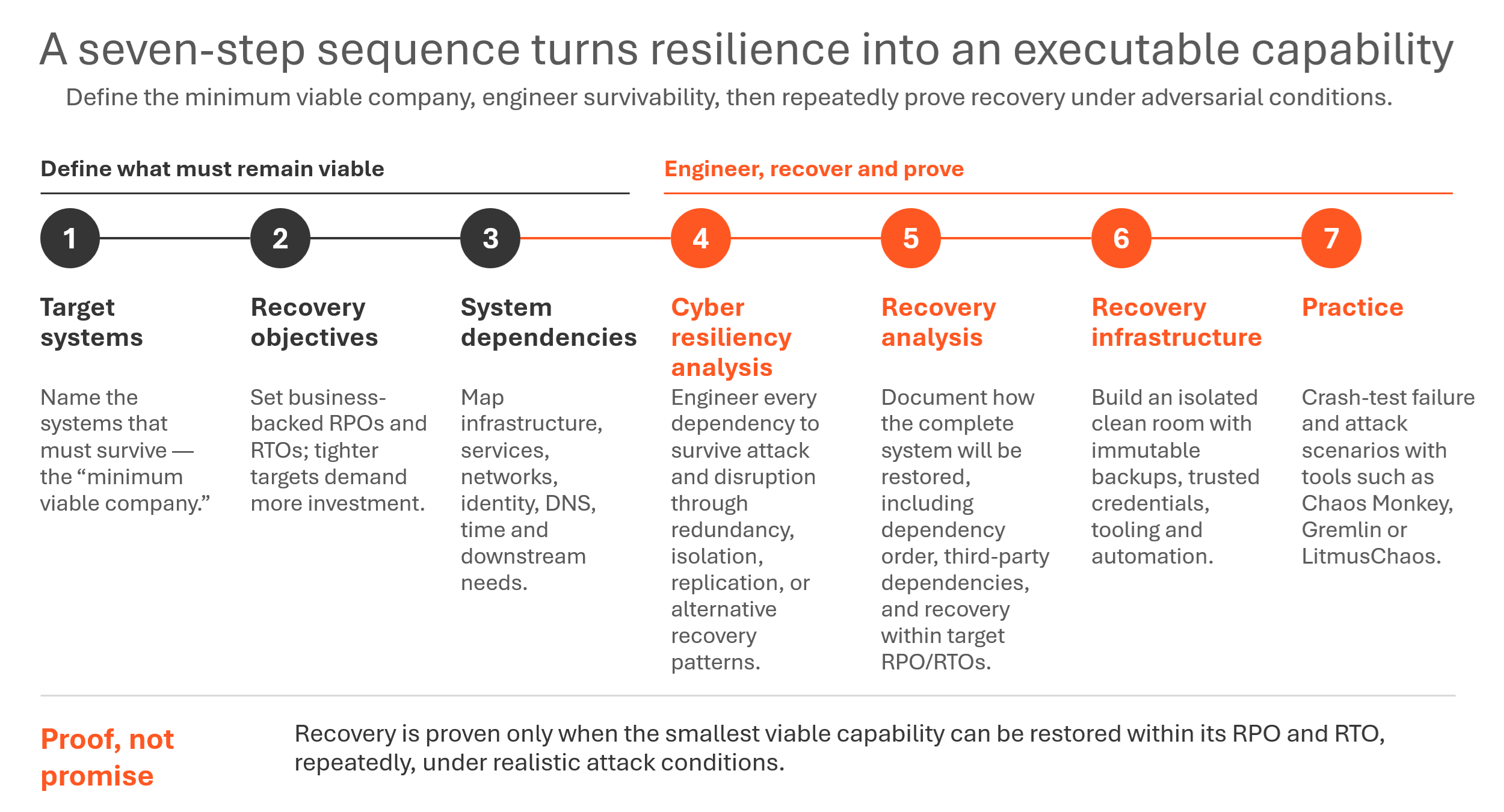
Figure 1: Resilience as a cybersecurity strategy: a seven-step framework for defining, engineering, recovering, and validating critical business capabilities.
From a resilience economics perspective, the goal is not to make the entire enterprise equally resilient. The goal is to make the MVC survive. The smaller the MVC boundary, the lower the cost of achieving meaningful resilience and the faster the organization can restore trustworthy operations during a contested recovery.
Resilience Economics: Strategic Capital Allocation & Blast-Radius Containment
Resilience economics seeks the smallest defensible operating boundary where additional resilience no longer reduces existential business risk enough to justify its incremental cost.
Resilience is often discussed as a technical discipline, but executive leaders should view it as an economic one. Every resilience investment is ultimately a capital allocation decision. The objective is not to create an environment in which every system can survive every conceivable attack. Such an objective is neither technically achievable nor financially sustainable. The objective is to identify the smallest viable capability required for organizational survival and concentrate resilience investments there.
This approach can be described as Resilience Economics: the practice of allocating security, recovery, and operational resources in a manner that minimizes the cost of organizational survival during a cyberattack. Under this model, resilience is no longer measured by the percentage of systems protected or the number of controls deployed. It is measured by the enterprise's ability to sustain critical operations while minimizing the resources required to recover.
The economic challenge is straightforward. Every workload, every identity, every administrative pathway, and every network connection expands the recovery surface that must be investigated, validated, rebuilt, or restored during an incident. As the operational estate grows, recovery complexity grows with it. If left unchecked, the cost of resilience eventually exceeds the value it was intended to protect.
The solution is not simply more recovery infrastructure. The solution is reducing the size of the problem that must be recovered.
Shrinking the Minimum Viable Company Boundary
Organizations frequently define a MVC by identifying critical business processes and the systems that support them. However, defining the MVC is only the first step. The greater opportunity lies in continuously shrinking its operational boundary.
Modern security architectures provide powerful mechanisms for accomplishing this objective. Technologies such as Security Service Edge (SSE), Secure Access Service Edge (SASE), identity-aware access controls, micro-segmentation, application-level isolation, and egress filtering limit what users, workloads, and systems are allowed to communicate with. Rather than assuming compromise can be prevented indefinitely, these controls assume an adversary will eventually gain access and therefore focus on constraining what the adversary can do next.
Every communication pathway that is removed from the environment becomes one less pathway an attacker can exploit. Every workload that cannot establish arbitrary outbound connections becomes one less location requiring extensive investigation during recovery. Every segment boundary that prevents lateral movement reduces the number of assets that must be considered potentially compromised.
From a resilience economics perspective, these controls are not merely security measures. They are mechanisms for reducing future recovery liabilities.
Constraining Adversary Movement
Traditional network architectures often provide attackers with broad freedom to move laterally once initial access has been achieved. Compromised identities can access excessive resources, workloads can communicate with systems they do not require, and outbound communications frequently occur with minimal scrutiny. The result is an expanding blast radius that increases both operational disruption and recovery costs.
Resilient architectures reverse this model. Identity becomes the primary security boundary. Network access becomes conditional. East-west traffic becomes constrained and observable. Outbound communications become explicitly authorized rather than implicitly permitted.
As these controls mature, attackers are increasingly forced into a smaller set of approved and monitored pathways. Their ability to establish persistence, pivot between systems, and expand their foothold becomes more difficult and more visible. Most importantly, their potential blast radius becomes bounded by architectural design rather than incident response luck.
Reducing Recovery Overhead
Blast-radius containment produces a second-order benefit that is often overlooked: it dramatically reduces recovery overhead.
During a contested recovery, organizations must determine which systems can be trusted, which identities remain valid, and which workloads require restoration. The larger the affected environment, the greater the uncertainty. Investigation expands. Validation efforts increase. Recovery timelines lengthen.
Architectural constraints reduce this burden. When workloads operate within narrowly defined communication patterns, recovery teams can verify behavior more quickly. When identity permissions are tightly scoped, compromised accounts affect fewer systems. When segmentation boundaries remain intact, recovery efforts can focus on specific portions of the environment rather than the entire enterprise.
The economic impact is substantial. Less infrastructure must be rebuilt. Fewer systems require forensic analysis. Smaller data sets require validation. Recovery teams can restore critical operations more rapidly because the number of variables has been reduced before the incident ever occurs.
In this way, resilience economics becomes a cycle of continuous optimization. Every architectural decision that constrains unnecessary access, limits blast radius, and reduces operational complexity lowers the future cost of survival. The enterprise is not merely becoming more secure. It is becoming less expensive to recover.
That distinction is what transforms resilience from a technical capability into a strategic business discipline.
The Next Horizon: Resilience in the Era of Agentic AI
The next major challenge for resilience engineering is not the recovery of traditional systems. It is the recovery of systems that can act independently. As organizations deploy fleets of increasingly capable AI agents, autonomous workflows, and tool-calling architectures, they introduce a new operational layer that traditional disaster recovery and business continuity planning were never designed to address.
The Non-Deterministic Execution Plane
Historically, enterprise systems were largely deterministic. An application performed a predefined function, executed a known workflow, and operated within relatively predictable boundaries. Recovery planning focused on restoring infrastructure, applications, data, and user access.
Agentic AI changes those assumptions. Modern AI agents can dynamically select tools, invoke APIs, generate code, chain actions together, retrieve information from multiple sources, and make operational decisions based on changing conditions. Rather than executing a fixed process, they operate within what can be described as a non-deterministic execution plane. This is an environment where behavior emerges from combinations of models, prompts, context, permissions, external data, and available tools.
This introduces entirely new failure modes. A compromised AI agent might abuse legitimate privileges at machine speed. A poisoned prompt might alter decision-making without compromising infrastructure. An external dependency might change its behavior and produce cascading consequences across interconnected workflows. Autonomous agents might perform actions that remain technically authorized while producing unintended operational outcomes.
Traditional disaster recovery assumes organizations are restoring systems. Increasingly, organizations might find themselves restoring trust in autonomous decision-making environments.
The challenge extends beyond recovering databases, virtual machines, and applications. Organizations must also understand how to recover AI agent configurations, tool permissions, orchestration logic, context stores, memory systems, and the governance controls that determine how autonomous systems behave. Restoring the infrastructure without restoring trustworthy AI agent behavior might simply recreate the conditions that enabled the failure.
Containing Machine-Speed Failure
The economic principles underlying resilience remain unchanged. What changes is the speed at which failures can propagate.
A compromised user account might affect dozens of systems. A compromised autonomous agent with broad tool access could potentially affect hundreds or thousands of systems in minutes. As AI systems become more capable, blast-radius containment becomes increasingly important.
Resilience Economics provides a useful framework for addressing this challenge. The objective is not to eliminate agent autonomy. After all, that's one of the biggest benefits of agentic AI. The objective is to ensure that autonomy operates within carefully bounded constraints.
Organizations should apply the same principles used to protect human operators to AI systems, often with greater rigor. Outbound communications should be governed and monitored. Tool access should be explicitly authorized and restricted to the minimum privileges necessary. Agent-to-agent communications should be observable and controllable. High-risk actions should require human approval before execution. Critical business functions should maintain human-in-the-loop checkpoints that prevent autonomous systems from making irreversible decisions without oversight.
These controls are frequently viewed through a cybersecurity lens, but they are equally important resilience mechanisms. Every restriction placed on an autonomous system reduces the potential blast radius of failure. Every bounded workflow reduces the number of systems that must be investigated during recovery. Every human approval gate creates an opportunity to interrupt machine-speed propagation before it reaches critical business assets.
Most importantly, these controls help protect the Minimum Viable Company. As organizations increasingly depend on autonomous systems, the MVC must include not only critical business services, but also the governance mechanisms that constrain how AI systems interact with those services.
The organizations that successfully navigate the agentic era will not be those that deploy the most autonomy. They will be those that understand where autonomy must stop. The future of cyber resilience will be defined not only by the ability to recover infrastructure, but by the ability to recover trustworthy decision-making under conditions of uncertainty, compromise, and machine-speed execution.
Executive Conclusion: The CISO's New Mandate
For decades, cybersecurity leaders have been asked variations of the same question: Are we secure? How many vulnerabilities remain? How likely are we to be breached? While important, these questions increasingly obscure a more consequential executive concern. In an era of ransomware, destructive attacks, supply chain compromise, and autonomous AI systems, leaders must assume that some failures will occur. The more important question is what happens next.
The defining resilience question for every board of directors and executive leadership team is deceptively simple:
What must come back first for us to still be a company?
Organizations that cannot answer this question have no meaningful resilience strategy. They might possess disaster recovery plans, incident response playbooks, backup technologies, and security controls, yet still lack a clear understanding of the capabilities required for organizational survival. During a severe cybersecurity event, uncertainty about priorities often becomes as damaging as the attack itself.
The purpose of resilience engineering is to eliminate that uncertainty. By defining a Minimum Viable Company, identifying its dependencies, engineering survivability into its critical capabilities, and repeatedly validating recovery under realistic conditions, organizations establish a defensible path back to trusted operations. Recovery transitions from a hope-based exercise into a measurable business capability.
This shift also changes the role of the modern Chief Information Security Officer. Historically, many CISOs were evaluated primarily as technology operators responsible for protecting systems and reducing risk. Increasingly, however, resilience requires a broader mandate. The CISO must become a business strategist capable of helping executive leadership determine where resilience investments create the greatest organizational value and where they do not.
Viewed through the lens of Resilience Economics, cybersecurity becomes less about pursuing perfect protection and more about optimizing for survival. Architectural decisions that constrain unnecessary complexity, restrict lateral movement, shrink blast radius, and reduce recovery overhead preserve capital long before an incident occurs. Every unnecessary dependency eliminated, every privilege boundary enforced, and every pathway removed from an adversary's reach reduces the future cost of recovery.
Ultimately, resilience is not measured by how much infrastructure an organization can rebuild. It is measured by how quickly the organization can restore trustworthy operations and continue fulfilling its mission while under pressure. The organizations that will thrive in the years ahead will not necessarily be those with the largest security budgets or the most sophisticated technologies. They will be those that clearly understand what must survive, invest accordingly, and repeatedly prove that survival is achievable under the most adverse conditions.
In the end, resilience is neither a technology problem nor a recovery problem. It is a business survival problem. The organizations that recognize this distinction will be the ones best positioned to endure whatever disruptions come next.
Selected References
1. National Institute of Standards and Technology (NIST), SP 800-207: Zero Trust Architecture, 2020.
2. National Institute of Standards and Technology (NIST), SP 800-160 Volume 2: Developing Cyber-Resilient Systems, 2021.
3. Cybersecurity and Infrastructure Security Agency (CISA), Cyber Resilience Review (CRR) Resource Guide.