If Malware Were a Country…

Many across the industry are rightly focused on the surge in vulnerability disclosures unlocked by new AI capabilities. But another milestone is approaching — one that is just as consequential. AI hasn’t only accelerated vulnerability discovery; it has industrialized the malware that exploits those vulnerabilities.
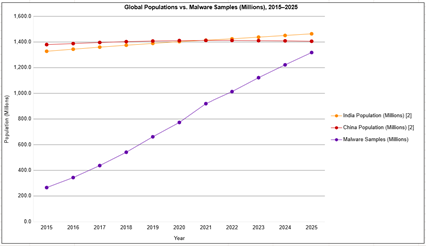
If malware were a country, it would become the most populated nation on Earth in 2026.
The number of malware samples collected by premier antimalware testing labs, such as AV‑Test, will exceed the individual populations of China and India this year. This shift didn’t happen overnight. The “population” of malware has been quietly and aggressively expanding for more than a decade.
Over the past ten years, AV‑Test’s malware corpus has grown at an average annual rate of 17.6%, adding roughly 105 million new samples per year. During that same period, China’s and India’s populations grew at 0.19% and 0.97%, respectively. As the graphs below illustrate, this divergence has enabled malware to eclipse the world’s most populous countries in a remarkably short time.
The Industrialization of Malware
Attackers have continuously evolved their methods to generate malware variants that evade detection. What began as manual obfuscation has become a fully automated production pipeline. Several forces have driven this exponential growth:
· Server‑side polymorphism
· AI‑assisted polymorphism and metamorphism
· Automated malware construction kits
These techniques allow attackers to produce millions of unique samples with minimal skill. The result is an automation arms race between malware authors and the antimalware industry — one that has fundamentally changed the scale of the problem.
The Next Decade: A Population Explosion
If current growth rates hold, the next ten years could be staggering:
· By 2030: Malware samples (~2.4 billion) would be 1.6× India’s population and nearly 1.7× China’s.
· By 2035: Malware would outnumber India’s population by nearly 3:1.
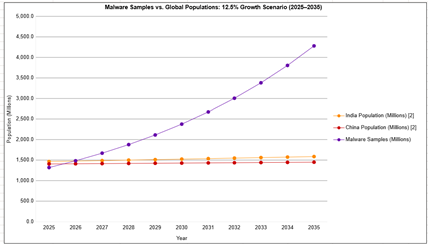
This is not a theoretical projection; it is a continuation of a decade‑long trend driven by automation, incentives, and attacker economics.
The Defender Imperative
The antimalware industry has made progress. Over the past five years, the average annual growth rate of malware samples has slowed to 12.5%. But if attackers use AI to generate millions of polymorphic variants, defenders must use AI to collapse those variants back into a manageable number.
The industry’s goal should be simple:
Drive malware growth below the five‑year average — and eventually reverse it.
This is the only sustainable path forward. Without it, the “malware country” will continue expanding faster than any human population ever has.
Data sources:
1. AV-Test. (2026). Total amount of malware and PUA. https://portal.av-atlas.org/malware
2. World Bank. (2024). Population, total [Data set]. World Bank Open Data. https://data.worldbank.org/indicator/SP.POP.TOTL
The views and opinions expressed in this post are my own and do not necessarily reflect the official policy or position of my current or past employers.