Government Access to Data: Policy Panic vs. Operational Reality

I worked in Europe during one of the most consequential periods for global cybersecurity policy — the early enforcement of GDPR and the passage of the CLOUD Act. As Amazon Web Services’ Cybersecurity and Compliance Leader for Europe, the Middle East, and Africa, I sat at the center of a shift that reshaped how governments, regulated industries, and multinational enterprises thought about cloud adoption.
I lived in London and spent significant time in Brussels, Berlin, Stockholm, and Paris meeting with government agencies and public‑sector organizations. My role was straightforward to describe but complex to execute: helping these organizations evaluate whether hyperscale cloud services could meet their most stringent cybersecurity and compliance requirements. Across hundreds of discussions with CISOs, CIOs, and policymakers, one topic consistently surfaced as their primary concern — government access to data.
Executives across Europe frequently raised questions about how U.S.-based cloud providers comply with laws such as the CLOUD Act, the PATRIOT Act, and the Foreign Intelligence Surveillance Act (FISA). These concerns were often informed by widely reported disclosures and public allegations regarding global surveillance programs. In this environment, the topic carried significant sensitivity, and many organizations approached it with understandable caution.
To make these conversations productive, I focused on translating the issue into risk‑based terms. Risk is a function of probability and impact. To help organizations assess probability, I relied exclusively on publicly available transparency reports published by major technology providers, including AWS, Microsoft, Google, Apple, and Meta. These reports offer empirical data on the frequency and nature of lawful government requests for information.
When you analyze the macro-level data, a very different picture emerges — one that rarely appears in policy debates.
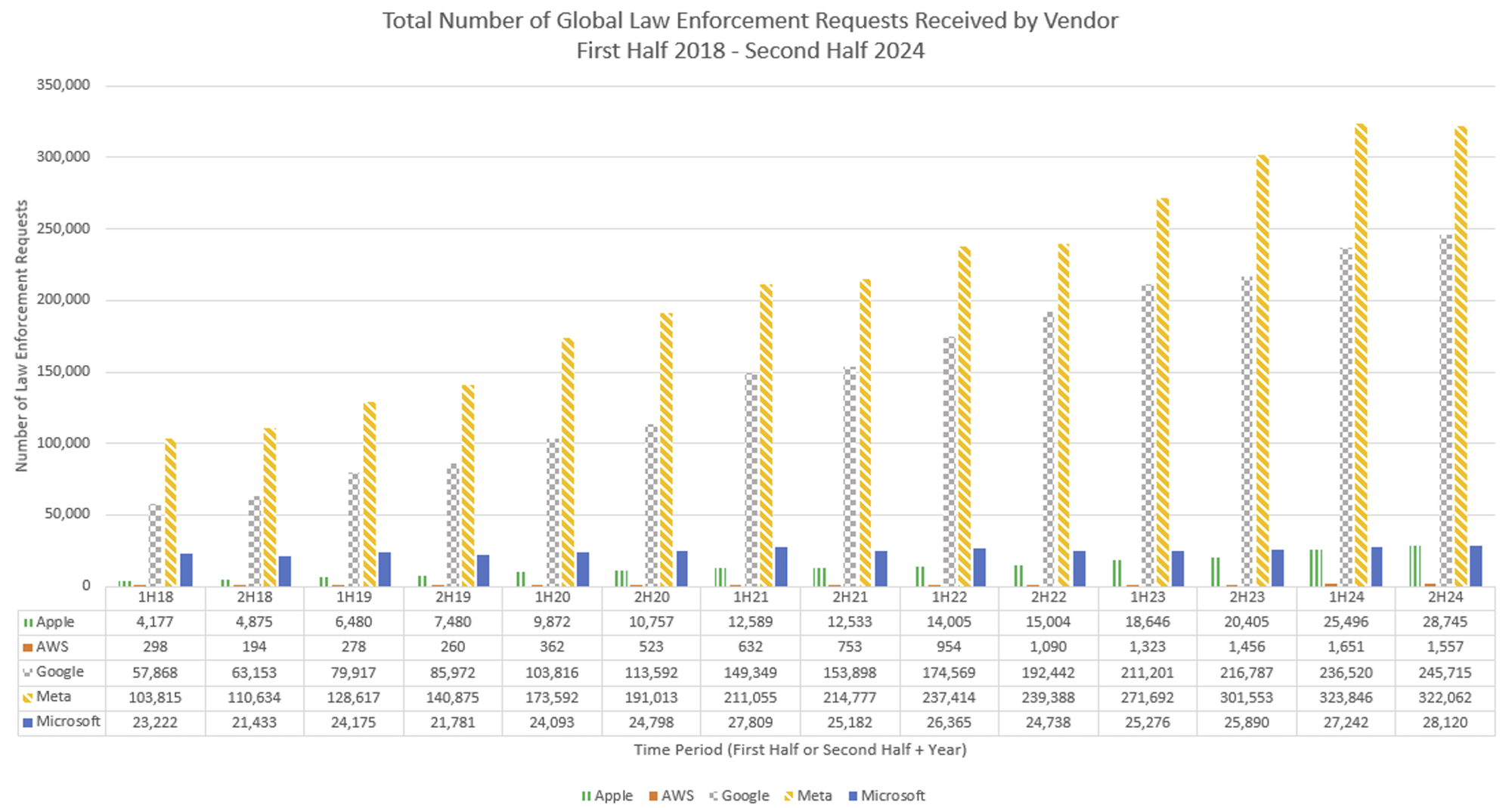
(Source: Compiled aggregate data from official Apple, AWS, Google, Meta, and Microsoft Transparency Reports, 2018–2024)
The Consumer vs. Enterprise Mismatch
Across all major providers, the overwhelming majority of government data requests target individual consumer accounts: personal email, chat logs, and consumer devices. Enterprise cloud infrastructure requests are a statistical anomaly.
This distinction matters. The public narrative treats “government access to cloud data” as if enterprises are the primary target. The empirical reality shows the opposite.
Metadata vs. Content: The Operational Gulf
There is also a massive difference between a government requesting metadata (connection logs, IP information) and demanding content (database records, files, structured enterprise data).
Outside the United States, enterprise content disclosure by major cloud providers is practically non‑existent.
For example, Microsoft’s transparency reports show the number of FISA orders issued between the second half of 2020 (2H20) and the second half of 2024 (2H24). Providers are only permitted to disclose these numbers in ranges, but even within those constraints, the pattern is clear: content-level enterprise disclosures are extraordinarily rare.

(Source: Microsoft Corporate Transparency Reports, U.S. National Security Orders metrics, 2020–2024)
The Bottom Line for CISOs, CIOs, and Policymakers
Data residency does not protect your cloud data from foreign governments the way policy debates suggest it does. If you are rewriting your global cloud strategy or expanding your budget based on emotional compliance panic rather than empirical threat models, you are misallocating resources.
The Probability
Legal, economic, financial, HR, and cybersecurity risks — malware, unpatched vulnerabilities, social engineering, stolen credentials, insider threats — all pose dramatically higher probability risks to enterprises than government access to data.
The Impact
Even when government access occurs, the impact is typically negligible. Enterprises do not go out of business because they received a warrant or a FISA order. In fact, most enterprises never publicly disclose such events because the operational consequences are minimal.
Effective risk management requires focusing limited resources on the highest-probability, highest-impact risks. For the vast majority of organizations, government access to data is neither.
The views and opinions expressed in this post are my own and do not necessarily reflect the official policy or position of my current or past employers.